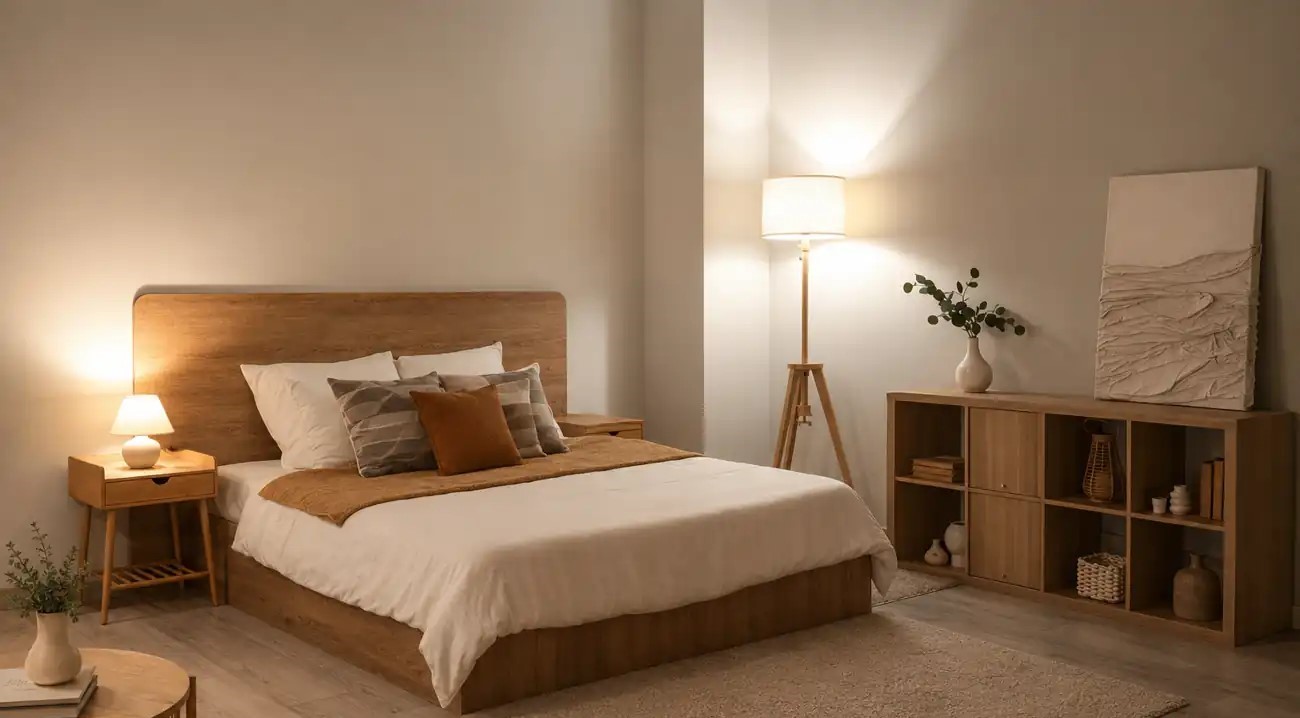
Bed direction according to Vastu for peaceful sleep
@font-face { font-family: ‘Heading2Font’; src: url(‘ format(‘opentype’); }
@font-face { font-family: ‘NOTOSANSREGULAR’; src: url(‘ format(‘truetype’); }
body { font-size: 15px !important; font family: ‘NOTOSANSREGULAR’; line-height: 1.7; }
h2 { font-family: ‘Heading2Font’; font size: 23px; line-height: 32px; bottom margin: 12 px; }
h3 { font-family: ‘Heading2Font’; font size: 20px; line-height: 28px; bottom margin: 10 px; }
.toc-container { border: 1px solid #e5e5e5; padding: 20px; border-radius: 12px; background: #fafafa; margin: 20px 0; }
Bed direction according to Vastu plays an important role in sleep quality, energy and overall well-being. Vastu recommends sleeping with your head facing south for stability and deep rest, or facing east for concentration and mental clarity. You should avoid sleeping with your head towards the north, while the west can only be used as a fallback. Integrating Vastu with practical bedroom planning can create a space that supports both comfort and daily living.
Most homeowners spend more time choosing a mattress than thinking about where the bed should be placed or which direction it faces. In Vastu Shastra, this positioning is not accidental. This is one of the most important decisions in any home.
The direction of your bed according to Vastu is based on the relationship between the human body, magnetic energy fields and directional forces. Some of this corresponds to modern science. Part of this is rooted in traditional belief. Regardless, the practical results—better sleep, reduced fatigue, and improved mental clarity—are worth taking seriously.
Why is bed direction according to Vastu important?
The Earth functions like a giant magnet whose north and south poles generate a continuous magnetic field. Vastu Shastra for homes always takes this fact into consideration, as its effects on the human body can be subtle but significant.
Sleeping with your head turned in certain directions aligns the body’s energy with the Earth’s magnetic pull. Others create resistance. Over time, this resistance manifests itself in sleep disturbances, fatigue, and in some cases, chronic health problems that seem unrelated to anything obvious.
It’s not abstract. Families who change the direction of their bed even slightly often report noticeably better sleep within a few weeks, without changing anything else.
What is the best bed direction according to Per Vastu?
The direction of the bed, according to Vastu, identifies two directions as clearly beneficial.
-
South: the most recommended direction
Sleeping with your head facing south is considered the gold standard. The south pole of the Earth’s magnetic field and the human body’s magnetic north align in this position, which promotes deep, uninterrupted sleep. It is also associated with stability, longevity and overall physical health.
-
East: Ideal for concentration and energy
Sleeping with your head facing east is considered very favorable for students, professionals and anyone whose daily life requires sustained mental performance. The East is associated with the rising sun, new beginnings and intellectual clarity. If you are wondering which direction is best to sleep, especially if you are under a lot of pressure due to exams or work, east is the ideal direction, according to Vastu.
It is worth noting that bed orientation as per Vastu recommends east, especially for children who need sound sleep, while south is generally preferred for elderly people and the head of the household.
Which directions should you avoid according to Vastu?
In which direction we should not sleep is just as important a question as in which direction we should.
-
North: the direction to avoid most strictly
This is the clearest guidance in the direction of the bed according to Vastu. Sleeping with your head facing north means that the body’s magnetic field opposes that of the earth, creating a kind of energetic friction.
Vastu associates this with sleep disturbances, increased stress and long-term health problems.
-
West: acceptable but not ideal
Sleeping with your head to the west is not considered harmful, but it is also not recommended as the main choice, as it is associated with restlessness and ambition, and sometimes even hyperactive dreams, which disrupt the quality of rest.
But in which direction should we sleep if none of the ideal options are available due to the room layout? The West is the acceptable fallback. The North must be avoided whatever the constraints.
How Bonito Designs integrates Vastu into bedroom planning
According to Vastu, the orientation of the bed is one of several factors Bonito Designs considers in bedroom design, alongside natural light, ventilation, storage requirements and how the household uses the space on a daily basis.
Our Life Design philosophy means Vastu is never applied as a rigid checklist that trumps practical needs. Instead, it is thoughtfully integrated, finding a layout that honors the directional principles while working with the actual constraints of the apartment.
Align your room with how you want to feel

Bed orientation according to Vastu is ultimately about giving sleep the same level of intention that governs all other design decisions in the home. The direction your head points while you rest is not a minor detail. It shapes the quality of your sleep and, by extension, the quality of your days.
The best direction for sleeping is south for most adults and east for those who need mental clarity and focus. Start there, work with your room layout and make adjustments that are within your reach.
If you want your bedroom planned around Vastu principles and the way you actually live, book a consultation with Bonito Designs today.
PakarPBN
A Private Blog Network (PBN) is a collection of websites that are controlled by a single individual or organization and used primarily to build backlinks to a “money site” in order to influence its ranking in search engines such as Google. The core idea behind a PBN is based on the importance of backlinks in Google’s ranking algorithm. Since Google views backlinks as signals of authority and trust, some website owners attempt to artificially create these signals through a controlled network of sites.
In a typical PBN setup, the owner acquires expired or aged domains that already have existing authority, backlinks, and history. These domains are rebuilt with new content and hosted separately, often using different IP addresses, hosting providers, themes, and ownership details to make them appear unrelated. Within the content published on these sites, links are strategically placed that point to the main website the owner wants to rank higher. By doing this, the owner attempts to pass link equity (also known as “link juice”) from the PBN sites to the target website.
The purpose of a PBN is to give the impression that the target website is naturally earning links from multiple independent sources. If done effectively, this can temporarily improve keyword rankings, increase organic visibility, and drive more traffic from search results.

Related Posts

15 Stylish Balcony Decoration Ideas for Modern Urban Homes

How Home Interior Design Shapes Your Mood