Vastu Tips for Pooja Room in a North Facing House
ol > li { position: relative; padding left: 25 px; bottom margin: 10 px; counterincrement: item; }
ol > li::before { content: counter(item) “.”; position: absolute; left: 0; }
.toc-container { border: 1px solid #e5e5e5; padding: 20px; border-radius: 12px; background: #fafafa; margin: 20px 0; }
.blog_content_con div { margin-bottom: 5px !important; } .blog_content_con p { margin: 0 0 6px 0 !important; }
A north facing house is considered auspicious in Vastu, especially when the entrance and key rooms are planned properly. For the Pooja room, northeast is the most favorable location, followed by east or north. Proper idol orientation, prayer direction and practical design choices can help create a spiritually balanced pooja space that fits comfortably into the layout of the home.
North facing houses enjoy a truly favorable status in Vastu. The north is ruled by Kuber, the deity of wealth and prosperity, and houses facing this direction are considered auspicious for financial growth and new opportunities. But the direction of the entrance alone does not determine the proper functioning of the house.
In a Vastu plan of a north facing house with a pooja room, it is important to place it well, both spiritually and practically. The location of key spaces, including the Pooja Room, determines whether these benefits are actually realized.
Why is a North Facing House Vastu Plan with Pooja Room considered auspicious?
Is a north facing house good or bad in Vastu? In short, it’s good, with a few drawbacks. North-facing homes receive good indirect light throughout the day, keeping interiors bright without the heat load of direct afternoon sun. Directional energy promotes prosperity and placement options for entry on the north wall are considered among the most favorable in all four orientations.
The caveat is that auspiciousness is a directional potential, not a guarantee. A north facing house Vastu plan that ignores the location of the kitchen, pooja room, bedrooms and entrance pada will not realize this potential. Below are some Vastu tips for north facing homes. These guidelines will help you build an ideal Pooja room based on your home layout.
Where to place the Pooja room in a north facing house?
The Pooja Vastu Room for North Facing Homes consistently indicates Northeast as the most suitable location. The northeast is the Ishanya corner, considered the most spiritually charged area of any house. It is associated with divine energy, clarity and incoming positive forces.
In a north-facing house with a Vastu plan and a pooja room, northeast works best because the direction of the house and the directional energy of the corner align. If northeast is not available due to the existing floor plan, east and north are the next best options. The East faces the rising sun and new beginnings, making it an ideal place to design a mandir. North, given its association with Kuber, is also considered appropriate.
What to avoid: South west location of pooja room is considered unfavorable in any Vastu plan of north facing house with pooja room. The southwest is the zone of stability and earth energy, which does not correspond to the lighter, spiritual quality of a prayer room.
What role does the leadership of idols and worship play?
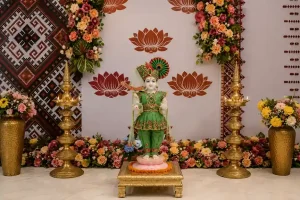
Once you have decided on the location of the Pooja room, the next important decision is the orientation of the idols:
- Pooja Room Vastu consistently recommends that idols face west, so that the person praying faces east. Facing north during prayer is also considered auspicious, meaning the idols would face south in this configuration.
- In a north facing Vastu house with a pooja room, the most natural setup is to place the idols on the west or south wall of the pooja room. The worshiper should enter from the east or north side and face east or north while praying.
- The platform or shelf of the mandir should be at chest height and not at floor level. The idol should not be placed directly against the wall, leaving a small space behind it.
Design Options in a North Facing House Vastu Plan with a Pooja Room
While most homeowners plan their pooja room facing north or northeast, the right design approaches for each home depend on what the floor plan allows:
-
Dedicated Pooja Room
Even a small 4-by-5-foot room in the northeast zone works well if it has a door, adequate ventilation and its own lighting.
-
Wall mounted mandir unit
A built-in wardrobe or open shelf on the north or north-east wall of the living or dining room can be a useful solution in a compact apartment in Mumbai where a dedicated room is not feasible.
-
Cabinet Style Pooja Unit
An enclosed unit with doors that can be opened during prayer and closed afterwards keeps the prayer space contained and visually neutral when not in use.
-
Niche mandir
A recessed wall niche in the northeast corner, equipped with a marble or stone platform and backlit with warm lighting, works well in homes with thicker walls or where construction allows for a setback.
-
Partitioned corner
A low partition or screen to the northeast of the living room can help create a semi-enclosed prayer area without a full room and is suitable for open-plan homes.
Design a North Facing House Vastu Plan with a Pooja Room You Deserve
In a country where 84% of Indian adults say religion is very important in their lives, the poop room is rarely an afterthought. A Vastu plan of a north facing house with a pooja room, when done well, creates a space that supports daily practice without compromising the layout or aesthetics of the house.
Bonito Designs integrates Vastu pooja room for north facing homes into the complete interior brief rather than treating it as a separate checklist. Our living design process ensures that the location, size and design of the Pooja Room are considered alongside all other rooms in the house, with practical compromises resolved at the planning stage rather than on site.
If you want a Vastu plan of a north facing house with a pooja room that truly meets the needs of your family, book a consultation with Bonito Designs today.
PakarPBN
A Private Blog Network (PBN) is a collection of websites that are controlled by a single individual or organization and used primarily to build backlinks to a “money site” in order to influence its ranking in search engines such as Google. The core idea behind a PBN is based on the importance of backlinks in Google’s ranking algorithm. Since Google views backlinks as signals of authority and trust, some website owners attempt to artificially create these signals through a controlled network of sites.
In a typical PBN setup, the owner acquires expired or aged domains that already have existing authority, backlinks, and history. These domains are rebuilt with new content and hosted separately, often using different IP addresses, hosting providers, themes, and ownership details to make them appear unrelated. Within the content published on these sites, links are strategically placed that point to the main website the owner wants to rank higher. By doing this, the owner attempts to pass link equity (also known as “link juice”) from the PBN sites to the target website.
The purpose of a PBN is to give the impression that the target website is naturally earning links from multiple independent sources. If done effectively, this can temporarily improve keyword rankings, increase organic visibility, and drive more traffic from search results.

Related Posts
15 Stylish Balcony Decoration Ideas for Modern Urban Homes
How Home Interior Design Shapes Your Mood